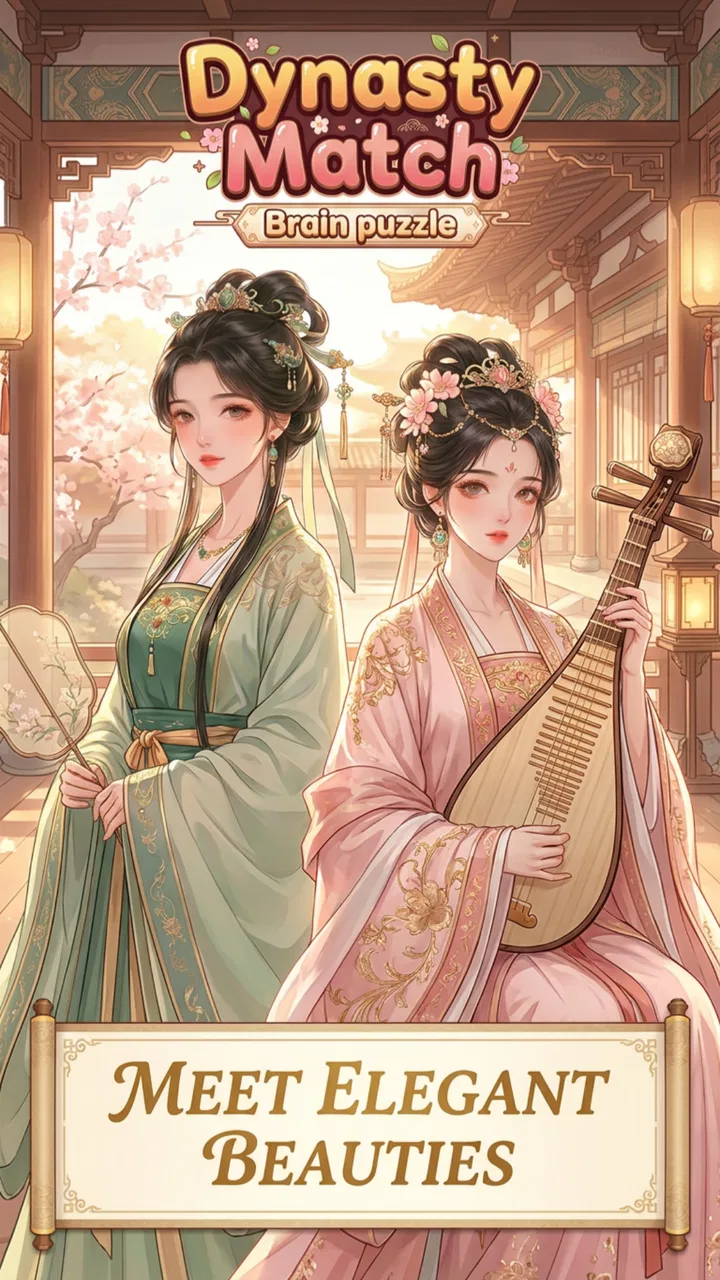
Dynasty Match: Brain Puzzle
- 4.3
- Rating
- 500.00K
- Installs
- Free
- Price

 Analysis by App-foxy
I approached Dynasty Match: Brain Puzzle expecting a light trivia-style game, but its appeal is less about answering questions and more about arranging objects with care. The central idea is simple: royal treasures must be dragged into suitable spaces, turning each round into a small visual challenge with a calming rhythm. It is the sort of game I can open for a short break without needing to remember a complicated story or learn a large set of rules.
That simplicity is also the key decision point. If you want a fast, relaxing puzzle that rewards observation and tidy placement, this game makes a good case for itself. If you are looking for deep trivia knowledge, competitive leaderboards, a long narrative, or a demanding brain-training system, I would look elsewhere. Luminous Arc Studios has chosen a narrow concept, and the experience works best when judged on how well it delivers that focused kind of play.
What to consider before choosing this puzzle game
The first question I would ask is what kind of mental activity you enjoy. This is listed as a Trivia game, but the moment-to-moment experience is driven by shape recognition, spatial judgment, and careful dragging. I did not play it as a quiz with right-or-wrong facts. I played it as a visual sorting exercise in which the satisfaction comes from making a cluttered arrangement look correct.
You May Also Like

 Blood Strike: 2.5 Anniversary
Blood Strike’s Loadouts Turn Every Drop Into a Tactical Gamble
A close look at Blood Strike’s custom loadouts: how fast access to signature weapons reshapes its battle royale rhythm, rewards preparation, and narrows the gap between fights.

 Pandora - Music & Podcasts
Pandora’s Music Is Easy to Start, but Harder to Recover
Pandora’s strength is its low-effort path from a seed to a station. Its weak spot is how much confidence it asks you to place in connection, setup, and quiet recovery.

 8 Ball Pool
 Is Built on Rivalries, Rematches, and Routine
A close look at the rivalries, rematches, shared routines, and unanswered safety questions that turn a quick pool match into a persistent mobile community.

 Samsung Music
’s Quiet Strength Is Playing What You Already Own
Its reach comes less from spectacle than from dependable access to a personal library. That simplicity is both the app’s strongest retention engine and its ceiling.

 AccuWeather: Weather Radar
AccuWeather Review: A Quick, Clear Forecast for Everyday Decisions
For everyday plans, the best forecast is the one you can understand quickly. AccuWeather makes rain timing, radar, and local conditions easy to act on, with a few trade-offs.

 Hill Climb Racing
Why Hill Climb Racing Still Turns Crashes Into One More Run
A tiny car, a bumpy hill and one more upgrade: Hill Climb Racing keeps resurfacing because its simple chaos makes every near-miss feel personal.
More From Our News Desk
View All News


That distinction matters when comparing it with the usual alternatives. Traditional trivia games test memory and general knowledge. Word puzzles focus on spelling, clues, or vocabulary. Match-three games usually depend on quick pattern recognition and chain reactions. Dynasty Match sits closer to a calm spatial puzzle, with a decorative royal theme giving the activity its identity.
I also considered how much attention the game demands. The basic interaction is approachable enough for casual players, and the Everyone age rating supports that broad accessibility. It does not present itself as a specialist puzzle tool, so I would recommend it to families and relaxed players before I would recommend it to someone seeking a serious test of logic.
Another practical criterion is commitment. The game is free to start, which makes trying it easy. There are in-app purchases priced at $4.99 per item, so I would still approach it with the usual caution around optional spending. The free entry is useful for deciding whether the movement and pacing suit you before you consider paying for anything.
Device compatibility is straightforward for many older phones and tablets because the minimum operating system is Android 7.0. That does not guarantee identical performance on every device, but it does make the game more approachable than titles that require a recent operating system. I would still keep the current version, 1.0.5, installed when possible, since puzzle games depend heavily on smooth touch response.
How the interaction feels in everyday use
The drag mechanic sounds basic, yet it is where the game either becomes relaxing or frustrating. I found that the best approach is to slow down during the first few seconds of a board rather than immediately moving the most obvious treasure. Looking at the available spaces first helps me avoid creating a cramped arrangement that needs to be undone later.
A useful habit is to identify the least flexible piece before touching anything. A long or unusually shaped treasure has fewer possible homes than a compact object, so placing it first reduces the number of later adjustments. This is a small strategy, but it changes the game from random dragging into a more deliberate process.
I also recommend treating the board as a layout problem rather than a race. When I rush, I tend to make near-correct placements and then spend more time correcting them. When I pause and compare the outline of an object with the available space, the experience becomes noticeably calmer. That makes it suitable for a short reset between tasks, especially when I want something interactive without the pressure of a timed action game.
Where its royal treasure theme helps
The royal setting gives the puzzles a clearer personality than a plain collection of geometric shapes would have. Treasures make the act of organizing feel like a small restoration task: I am not merely fitting anonymous pieces together, I am putting a display back into order. That framing is modest, but it helps the game avoid feeling like a completely abstract exercise.
The theme also makes the game easier to explain to a younger player. I can imagine handing it to someone who enjoys decorative objects, rooms, collections, or fantasy settings and letting them discover the rules through touch. Because the age rating is Everyone, it is a reasonable candidate for shared casual play, although I would still supervise purchases on a family device.
Its strongest audience is therefore not necessarily the person who wants the hardest puzzle available. It is the person who likes visual order, gentle repetition, and a clear goal on each screen. The game has a pleasant niche: it turns tidying and fitting into a small form of entertainment.
Where Dynasty Match makes the strongest case
The biggest advantage is immediacy. I do not need to study a long tutorial or understand a complicated progression system before I can begin. The core action is visible, physical, and easy to test with a finger. That makes the game a good choice for short sessions when I want to play immediately rather than invest time in setup.
It also succeeds as a low-pressure alternative to more hectic mobile games. There is no need to build a team, memorize a large ruleset, or react to several things at once. The attention goes toward the arrangement in front of me. For a commuter waiting for a connection, a parent taking a quiet break, or anyone winding down before bed, that focused simplicity can be more appealing than constant stimulation.
One non-obvious strength is that the game encourages a useful visual workflow. I naturally began separating decisions into three stages: scan the board, place the most restrictive pieces, and use the remaining open areas for easier objects. That workflow is transferable to other spatial puzzles, but here it emerges without requiring a formal tutorial. The game teaches patience through its interaction rather than through instructions.
Another strength is its suitability for interrupted play. A puzzle based on arranging individual objects is easier to return to than a story-heavy game in which I need to remember dialogue, objectives, or a map position. If I put the phone down during a short session, I can usually understand the immediate task again quickly. That makes it more practical for fragmented free time than many larger mobile games.
The public response is encouraging without needing to be treated as a guarantee. Dynasty Match has a 4.8 average from around 307 ratings, and it has passed 100K installs. I read those figures as evidence that the concept is connecting with a meaningful group of players, not as proof that every player will enjoy the same pace. The relatively small review count also reminds me to judge the game by its actual fit for my habits rather than by popularity alone.
Three practical ways to get more from each session
First, I would play with a “largest constraint first” rule. Instead of selecting the prettiest treasure or the one nearest to my finger, I look for the piece with the fewest plausible destinations. This reduces unnecessary reshuffling and makes later decisions more obvious.
Second, I would leave a little visual breathing room while planning. A placement that technically fits may still make neighboring pieces harder to see or reach. Keeping the central area readable helps me compare outlines and prevents a chain of accidental moves. This is especially useful on a smaller phone screen, where a crowded board can make precision more difficult.
Third, I would use the game as a deliberate transition between activities rather than as background noise. Five focused minutes after work, before studying, or during a waiting period can feel more restorative than endlessly scrolling. The benefit comes from paying attention to one contained problem, not from leaving the game open while doing something else.
These habits reveal a trade-off. The game is relaxing because it is focused, but that focus can feel repetitive if I play for a long stretch. I enjoy it more in compact sessions than in an extended marathon. Players who need constant novelty may notice the limited central idea sooner than players who like polishing one type of task.
Who should probably choose it
I would point this game toward casual puzzle fans who enjoy fitting objects, organizing visual spaces, and solving problems without a harsh penalty for taking time. It is also a good starting point for someone who finds conventional trivia intimidating but still wants a game categorized in that area. The royal treasure presentation gives the activity enough flavor to feel more inviting than a bare shape-fitting board.
It may work well on a shared family device because the age rating is Everyone and the interaction is easy to demonstrate. I would explain the spending option before handing over the phone, particularly if children can access the store controls. The free price makes the first trial uncomplicated, but optional purchases mean the game should still be treated like any other free-to-start title.
I would not choose it as my primary game if I wanted detailed factual quizzes, competitive knowledge testing, multiplayer rivalry, or a dramatic adventure. Someone who enjoys wordplay may get more satisfaction from a crossword-style game, while someone who wants rapid rewards may prefer a match-three title. Dynasty Match is not trying to replace those experiences; it is better understood as a quieter, more tactile option.
When another category may fit better
The closest alternative depends on what you mean by “brain puzzle.” If you want to exercise recall, a traditional trivia app is a better match because it asks you to retrieve information rather than judge shapes. If you want language practice, a word game gives you a more direct reason to think about spelling and meaning. If you want a fast burst of visual excitement, a match-three game usually offers more immediate action.
Compared with those categories, this game wins on calm concentration but gives up breadth. Its core activity is easier to understand, yet it may not provide the same sense of discovery that comes from learning facts, unlocking a narrative, or solving increasingly varied word clues. That is not a flaw in isolation; it is a reason to choose it only if the fitting-and-organizing loop genuinely appeals to you.
There is also a difference in how progress feels. In a knowledge quiz, improvement can come from remembering more answers. In a word game, it can come from expanding vocabulary. Here, improvement is more about reading space efficiently and making cleaner decisions. That kind of progress is subtle. I notice it when I stop moving pieces randomly and start planning an entire arrangement before committing to the first drag.
Players who dislike touch precision should think carefully before switching from a tap-based game. Dragging an object into a particular space can demand more control than selecting an answer. On a compact screen, fingers may obscure the target, and repeated corrections can remove some of the calm the game is designed to create. A larger display may make the experience more comfortable, but the important point is that the interaction itself is central to the choice.
Likewise, people who expect a deep long-term system may find the focused design too narrow. I would not install it hoping for a full role-playing game, a broad collection of trivia subjects, or a complex competitive ladder. Its value is in the quality of a small repeated activity, not in the number of unrelated systems layered on top.
The real cost of changing from another puzzle
Switching to Dynasty Match is easy when the main thing I want is a different mood. I can move from a noisy action game into a slower visual task without changing my expectations too much. The learning cost is low because the drag-and-fit idea is immediately readable, and the free price allows a practical trial before I decide whether it deserves regular space on my device.
The larger cost is opportunity cost. Every game competes for limited attention, and this one asks me to accept repetition in exchange for calm. If I already have a puzzle that offers more variety, stronger progression, or a better fit for my preferred style, switching may not improve my routine. I would keep both only if I wanted two distinct moods: one for challenge and one for decompression.
Purchases deserve a second look during that decision. Individual in-app items cost $4.99, so I would avoid buying anything immediately. I would first test the game across several short sessions, including one when I am tired and one when I am looking for a more active challenge. That gives a clearer sense of whether the relaxing loop remains enjoyable or starts to feel like repetition.
The developer is Luminous Arc Studios, and the current release is version 1.0.5. For a new player, the practical takeaway is to update before forming a final opinion, then pay attention to how reliably the drag controls respond on the device being used. A puzzle can be conceptually excellent and still feel wrong if touch placement is uncomfortable.
A realistic daily scenario
Imagine finishing a short lunch break with a few minutes left before returning to work. I would open the game, scan the treasure layout, and use the largest or least flexible object to establish the arrangement. Rather than trying to complete everything quickly, I would make a few deliberate placements, pause when the board became crowded, and finish the remaining spaces through comparison.
That scenario captures the game’s best use. It gives my attention one small, bounded task and does not require emotional investment in a story or competition with strangers. If I only have a brief window, I can stop without feeling that I have abandoned a major objective. If I have more time, I can continue, but I would still prefer several short sessions to one very long one.
For a child, the same activity could become a gentle exercise in matching outlines and planning space. For an adult, it may work as a screen-based version of tidying a display cabinet. Neither use turns it into an educational tool or a formal cognitive program, but both explain why the tactile organization has more staying power than the short store summary suggests.
My recommendation after weighing the trade-offs
I recommend Dynasty Match to anyone who wants a free, approachable mobile puzzle built around arranging royal treasures and taking a calmer route through problem-solving. Its best qualities are the clear interaction, the distinctive theme, the low barrier to entry, and the way it rewards thoughtful placement instead of frantic tapping. The Everyone rating and Android 7.0 minimum also make it accessible to a broad range of casual players.
I would skip it if your definition of a trivia game means a serious test of facts, or if you need extensive variety, competitive features, or a strong narrative. I would also be cautious about spending until the central loop has earned a place in your routine. The optional items cost $4.99 each, and no purchase can change the basic question of whether you enjoy dragging pieces into their proper spaces.
My final judgment is positive but deliberately specific: this is a good choice for short, quiet sessions, not a universal replacement for every puzzle category. I like it most when I treat it as a visual reset rather than a game I must grind for hours. Choose it for focused tidying, gentle spatial thinking, and easy drop-in play; choose another category when you want knowledge testing, wordplay, speed, or deep progression.
That clear positioning is what makes the game worth trying. It does not need to be the most complex puzzle on a phone to be useful. When I want a small task with a decorative setting and a satisfying sense of order, it gives me exactly that. When I want novelty or intensity, I know to switch elsewhere. For the right player, that honesty of purpose is its strongest feature.
FAQs for Dynasty Match: Brain Puzzle
01What is Dynasty Match: Brain Puzzle?
Dynasty Match: Brain Puzzle is a challenging puzzle game that combines strategic thinking with engaging gameplay. Players are tasked with matching tiles and solving intricate puzzles inspired by ancient dynasties. The game offers multiple levels of difficulty, making it suitable for both casual players and puzzle enthusiasts.
02Is Dynasty Match: Brain Puzzle free to play?
Yes, Dynasty Match: Brain Puzzle is free to download and play. However, it does offer in-app purchases for players who wish to enhance their gaming experience. These purchases can include extra lives, special boosters, or ad-free gameplay options.
03What are the main features of Dynasty Match: Brain Puzzle?
The game boasts a variety of features such as stunning graphics, hundreds of levels, and a captivating storyline. Players can enjoy daily challenges, participate in seasonal events, and unlock achievements. The intuitive touch controls and strategic gameplay mechanics make it a must-try for puzzle lovers.
04Does Dynasty Match: Brain Puzzle require an internet connection?
While Dynasty Match: Brain Puzzle can be played offline, certain features such as daily challenges, events, and leaderboard rankings require an internet connection. Playing online also ensures that your progress is saved and synchronized across devices.
05Are there any ads in Dynasty Match: Brain Puzzle?
Yes, the game includes ads that help support its free-to-play model. However, players have the option to remove ads through in-app purchases. This provides an uninterrupted gaming experience for those who prefer to play without advertisements.
Pros
- Engaging puzzles with increasing difficulty.
- Visually appealing graphics and design.
- Intuitive controls for easy navigation.
- Regular updates with new challenges.
- Offline play available for convenience.
Cons
- Contains ads that can disrupt gameplay.
- Limited hints available without purchase.
- Some puzzles may feel repetitive.
- In-app purchases can become costly.
- Requires occasional internet for updates.

Dynasty Match: Brain Puzzle
Gallery